
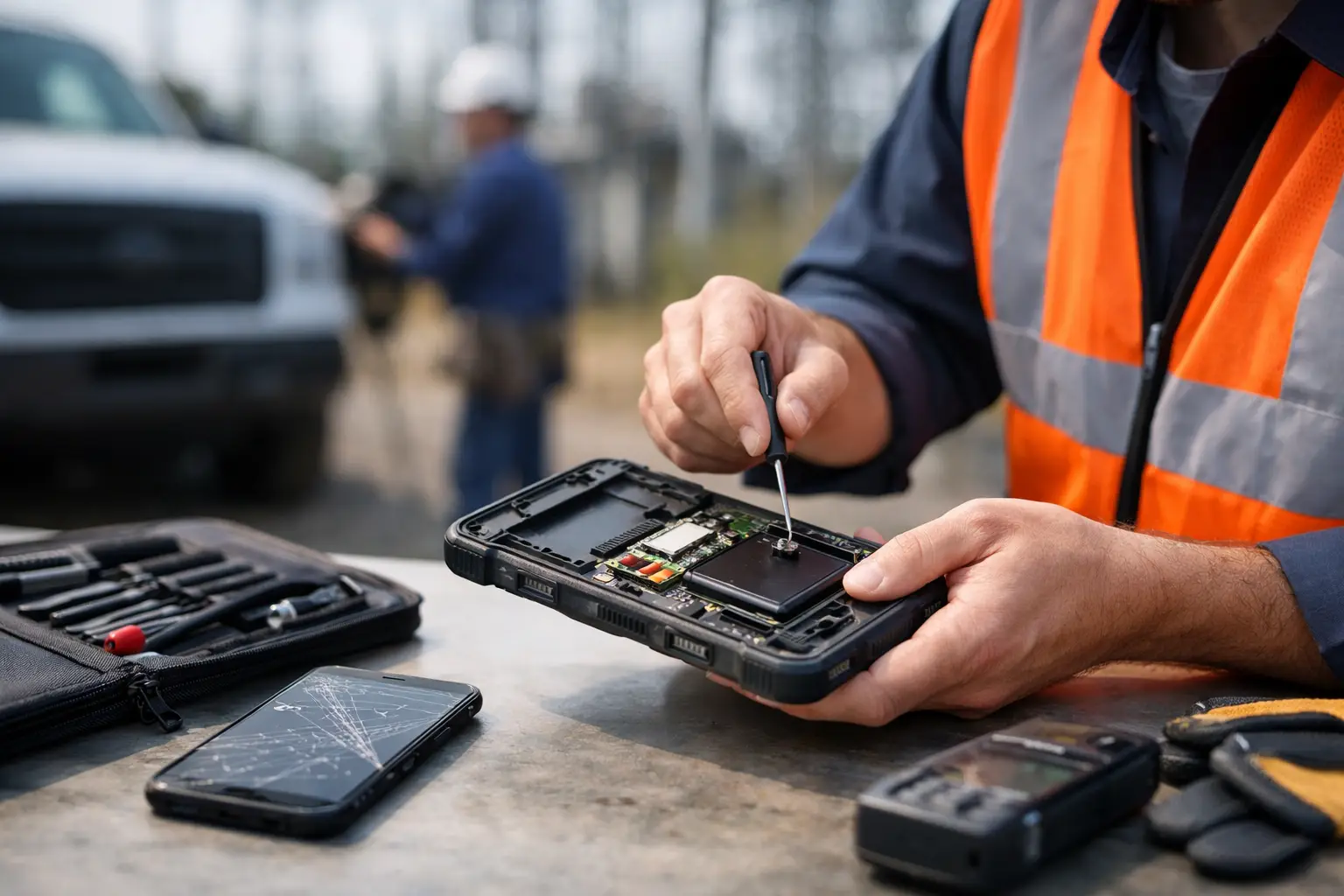
A phone that will not charge is not a small problem when it belongs to someone working out on the road. In this field team device repair case study, a local service business faced a familiar issue: several employees depended on their phones for jobs, customer updates, navigation and photos, but damaged devices were steadily slowing the team down.
The company did not need a complicated IT programme. It needed practical repairs, clear communication and a way to get its people back to work without sending every handset away for days. That is where a planned on-site repair visit made the difference.
The problem: small faults were creating bigger delays
The business had a field team of twelve people travelling between customer locations in and around Maarssen. Each person used a smartphone as their main work tool. The devices handled incoming jobs, calls, route planning, digital forms, photographs and messaging with the office.
Over a few months, the issues had built up. Three phones had cracked screens, two batteries were draining before the working day ended, one charging port only worked when the cable was held at an angle, and another device had a damaged back cover. None of these faults stopped the whole business at once. Together, however, they were costing time every day.
Employees were borrowing charging cables, returning to the office to collect spare devices and delaying photo updates until later. One worker was using a handset with a badly cracked display because they did not want to lose access to customer details while it was being repaired. That created another risk: a minor accident could have become a complete device failure.
The operations manager wanted to avoid replacing every phone. Several were still performing well apart from one specific fault, and full replacement would have been needlessly expensive. The priority was to restore reliable use quickly while protecting the company’s data and keeping disruption low.
Planning the field team device repair case study
Before any repair work began, the devices were checked through free diagnostics. This mattered because the visible fault is not always the only fault. A phone that seems to have a battery issue may have a charging-port problem. A screen that looks damaged after a drop may also have a weakened frame or touch sensitivity issue.
The diagnostic check gave the business a clear picture of what could be repaired, what parts were needed and where a repair was the sensible option. It also allowed the manager to approve costs before work started. For a business managing multiple handsets, that transparency is more useful than a vague estimate or a surprise invoice after the fact.
The repair visit was organised around the team’s work schedule. Rather than asking every employee to travel to a repair shop during working hours, the devices were collected at a single location and handled in sequence. Staff could hand over their phone, use a temporary device where necessary, and return to their appointments with minimal interruption.
This approach will not suit every situation. A device with serious board-level damage, water damage or a part that is not immediately available may need more time. But for common faults such as screens, batteries, charging ports and back covers, on-site or planned business repair support can remove much of the usual inconvenience.
What was repaired and why it mattered
The three cracked screens were replaced with high-quality replacement parts. This restored clear displays and reliable touch response, but it also reduced the chance of cuts, moisture entering the device or the crack spreading across the screen. For field workers entering forms or showing customers photographs, a responsive screen is a working requirement, not simply a cosmetic improvement.
The two battery replacements addressed a different kind of downtime. A battery that falls from 60 per cent to 15 per cent in a short period changes how someone works. They start searching for sockets, carrying power banks and avoiding calls or navigation to preserve charge. After replacement, both phones could again support a normal shift with far less charging anxiety. Battery repair was completed with warranty-backed work, giving the business reassurance beyond the day of the repair.
The damaged charging port required careful cleaning and repair. Lint, dust and repeated strain on a cable can prevent a phone from charging properly. In some cases, professional cleaning is enough. In this instance, the port showed physical wear and needed repair to provide a stable connection again.
The broken back cover was replaced to protect the internal components. Back-cover damage can look harmless, especially if the phone still turns on. Yet a loose or cracked cover leaves a device more exposed to dust, moisture and further impact. Repairing it early helped avoid a more expensive fault later.
No unnecessary work was added. One handset that initially appeared to need a new battery was found to have a software issue affecting power use. After an update and settings check, the battery performance improved without replacing a part. This is exactly why diagnosis should come before repair.
The result: fewer workarounds, more reliable days
By the end of the visit, the team had six repaired devices and one software issue resolved. The immediate benefit was simple: employees could make calls, use navigation, upload job information and take customer photographs without adapting their day around a faulty phone.
For the operations manager, the larger gain was predictability. Instead of responding to individual problems as they became urgent, the company had dealt with a group of known faults in one organised session. There was less time spent arranging ad-hoc replacements, fewer interruptions for office staff and less uncertainty about whether a device would last through the day.
The cost comparison also favoured repair. Replacing multiple handsets would have required a larger upfront spend, time to set up new devices and potential disruption while accounts, apps and security settings were transferred. Repair was not automatically the right answer for every device, especially older models with several major faults. In this case, though, the phones still met the team’s needs once their specific problems were fixed.
Data protection was another consideration. The business did not want staff passing devices around or attempting repairs themselves. Professional handling, with a clear process for diagnostics and repair, reduced the risk of accidental data loss. Where software work or data transfer is needed, it is sensible to agree access requirements and backups with the repair technician beforehand.
What other businesses can take from this case
Field teams often tolerate phone problems for too long because each issue feels manageable in isolation. A cracked screen still works. A weak battery can be charged in the van. A cable can be held in the right position. But those workarounds consume attention and time, particularly when employees are away from the office.
A better approach is to review devices before faults become urgent. Ask staff whether batteries last a full shift, whether charging is reliable, whether screens remain easy to read outdoors and whether calls, cameras and work apps are functioning as expected. A short device check can identify patterns before they affect customer service.
It also helps to separate repair decisions into three questions. Is the device otherwise suitable for the employee’s work? Is the fault repairable at a sensible cost? And can the repair be planned around operations? When the answer is yes, repair can extend the useful life of a device and avoid an unnecessary replacement cycle.
For companies with several makes and models, a multi-brand repair provider is especially practical. Teams rarely use only one manufacturer forever. Over time, an organisation may have Apple, Samsung, Google, Xiaomi or other devices in circulation. Support that can assess each handset on its own condition keeps the process straightforward.
A practical next step for a busy team
Logiexpert Smartphone Repairs supports businesses that need fast, dependable mobile-device repairs with minimal disruption. From a single charging problem to a planned repair session for a wider field team, the aim is to identify the fault clearly, use quality parts and return devices to useful service as quickly as possible. If a repair cannot be completed, you do not pay.
The most helpful time to arrange a device check is usually before the next missed call, failed upload or flat battery affects a customer visit. A phone is part of the job kit. Treating it that way keeps your team focused on the work in front of them.
Lascia un commento