
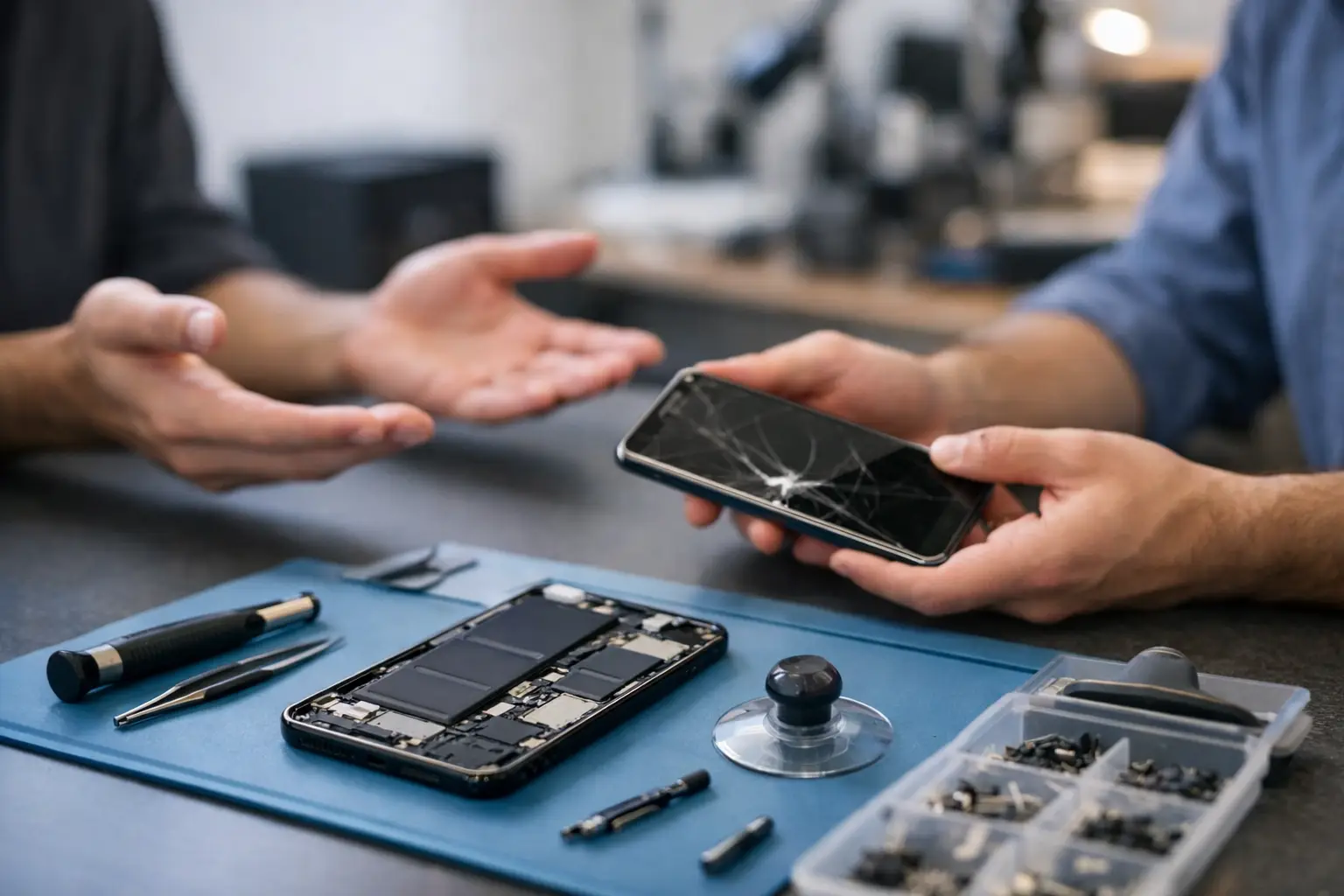
A phone can fail at the worst possible moment: while you are approving a banking payment, finding your way home, joining a work call or trying to reach family. No fix no fee phone repair gives you a straightforward place to start. If a technician cannot repair the fault, you should not be charged for a repair that did not solve the problem.
That promise matters because a fault is not always what it first appears to be. A phone that will not charge may have a damaged charging port, but it could also have a worn battery, moisture damage, a software issue or a faulty cable. Proper diagnosis protects you from paying for the wrong work and gives you a clear view of your options before any repair begins.
What no fix no fee phone repair should mean
The principle is simple: bring in the device, let an experienced technician assess it, and receive an honest recommendation. If the fault can be fixed and you approve the price, the repair goes ahead. If it cannot be fixed, there is no repair bill to pay.
It is not the same as promising that every phone can be saved. Some devices have severe liquid damage, board-level faults, unavailable parts or damage that makes a safe, lasting repair unrealistic. A reliable repair service will explain this plainly rather than fitting a part that is unlikely to help.
The key benefit is accountability. You are paying for a working outcome, not for guesswork. That is particularly reassuring when the problem is intermittent, such as a phone that switches off at 30 per cent battery, loses signal at random or only charges when the cable is held at a certain angle.
A diagnosis should come before a quote
A good diagnostic check considers more than the visible issue. With a cracked display, the technician may also test touch response, brightness, cameras, proximity sensors and the frame. With battery problems, they should check charging behaviour and power use as well as the battery itself.
Only after those checks can a meaningful quote be given. The exact price depends on the model, the condition of the device and the quality and availability of the required part. Clear pricing means you know what is included before approving the work, with no surprise charge added because the original diagnosis was rushed.
Which faults are usually worth repairing?
Most everyday phone faults can be repaired quickly and cost-effectively, especially when the device is otherwise in good condition. Screen replacements are a common example. A shattered screen may look dramatic, but the repair is often far more sensible than replacing a recent handset.
Battery replacement is another practical repair. If your phone needs charging several times a day, becomes unusually warm or shuts down unexpectedly, a new battery can extend its useful life. For a dependable result, the replacement should be high quality and covered by a warranty where applicable.
Charging-port repairs can also make a major difference. Pocket fluff, debris and worn connectors are frequent causes of unreliable charging. Sometimes careful cleaning resolves the problem. In other cases, the port itself needs repair or replacement. A technician should test the device first rather than assuming a new port is necessary.
Back-cover replacement, camera issues, speaker faults, damaged buttons, software updates, data transfers and device resets can all be worthwhile too. The right choice depends on the age and value of the device. Repairing a two-year-old phone with one clear fault is often sensible. A much older phone with several serious faults may be better replaced, and a trustworthy technician will say so.
What happens during a repair?
After the initial inspection, you should receive a clear explanation of the fault, the recommended repair and the expected cost. This is the point to ask questions. Will the repair affect water resistance? Is there a warranty on the part? How long will the repair take? Are your photos and apps likely to remain on the device?
For many screen, battery and charging issues, the repair process is direct: the faulty component is removed, a suitable replacement part is installed, and the phone is tested before it is returned. Testing should cover the functions related to the repair as well as essential features such as charging, touch controls, microphones and cameras where relevant.
More complex faults can take longer. Liquid damage, repeated rebooting and faults on the main board may require deeper assessment. No fix no fee protection is especially valuable in these situations because the repair path is less predictable. It means the customer can make a decision based on evidence, rather than committing to an uncertain repair from the outset.
Your data needs sensible care
A repair should focus on keeping your device and data intact, but no technician can guarantee data preservation in every circumstance. A severely damaged phone may fail during testing, and a software reset can erase information. If the phone still works, back it up before handing it over whenever possible.
If you cannot back it up, mention this at the start. The technician can advise whether a repair is likely to preserve the data, whether a transfer is possible or whether recovery should be considered separately. Do not delay if the phone has been exposed to water. Switch it off, avoid charging it and arrange an assessment quickly.
Why part quality and technician skill matter
The lowest quote is not always the best value. Poor-quality screens can have weak brightness, inaccurate colours or unreliable touch response. Low-grade batteries may lose capacity quickly. A repair that initially looks cheap can become expensive if the part fails soon afterwards or causes another problem.
Experienced technicians also know when not to force a repair. They inspect adhesive seals, internal connectors, screws and the device frame, then test carefully after reassembly. This matters across Apple, Samsung, Google, Xiaomi, Huawei, Oppo, OnePlus, Oukitel and other brands, because every model has different parts, layouts and repair risks.
At Logiexpert Smartphone Repairs, the approach is practical: assess the fault, explain the options and work towards a repair that lasts. For private customers, that means getting a vital phone back into daily use. For businesses, it means reducing downtime when staff devices are needed for calls, deliveries, customer service or mobile administration.
When a no-fix-no-fee policy has limits
Always ask how the policy applies to your particular device. The repair itself may be free if it cannot be completed, while special-order parts, data-recovery attempts or work already approved by the customer may be treated differently. Terms should be explained before work starts.
It is also worth separating diagnosis from an upgrade decision. If a technician finds that a repair is possible but you decide not to proceed, ask whether there is an inspection charge. A transparent service will make this clear in advance. The aim is not to catch customers out, but to ensure both sides understand what is being authorised.
For company devices, agree the process before sending multiple phones for repair. A simple approval route, device list and contact person prevent delays. On-site repair can be useful where moving devices off premises would interrupt staff or operations.
Choosing a repair service with confidence
Look for a repairer that explains faults in plain language, offers a quote before work and tests the device properly afterwards. Free diagnostics, quality parts, reasonable turnaround times and warranty support are stronger signs of value than an unusually low headline price.
Bring the phone, any relevant passcode details needed for testing, and the charging cable if the issue involves power. Describe exactly when the fault occurs and whether the device has been dropped, exposed to moisture or recently updated. Small details can speed up diagnosis.
Your phone does not need to become another expensive replacement purchase because one part has failed. Start with a proper assessment, ask for clear terms and choose a repairer prepared to stand behind the result. If it can be fixed, you deserve a repair that restores confidence as well as function.
Lascia un commento